Last week, a frustrated executive client told me, “I’m posting three times a week on LinkedIn, but I’m getting half the views I used to. What am I doing wrong?”
My answer was “You might be playing by last year’s LinkedIn algorithm.”
If you’ve noticed your LinkedIn engagement dropping dramatically, you’re not imagining it. According to the Algorithm Insights 2025 report by LinkedIn expert Richard van der Blom:
- Views are down 50%
- Engagement is down 25%
- Follower growth is down 59%
- Average post reach: 8-12% of followers (down from 15-20%)
The 2026 LinkedIn algorithm has fundamentally changed, and as a job seeker and professional, you need to adapt your strategy so your content reaches the people who matter most to your career.
Here’s how LinkedIn’s 2026 algorithm affects you, and how you can optimize your content to extend its reach the way it was intended.
Expertise Over Virality
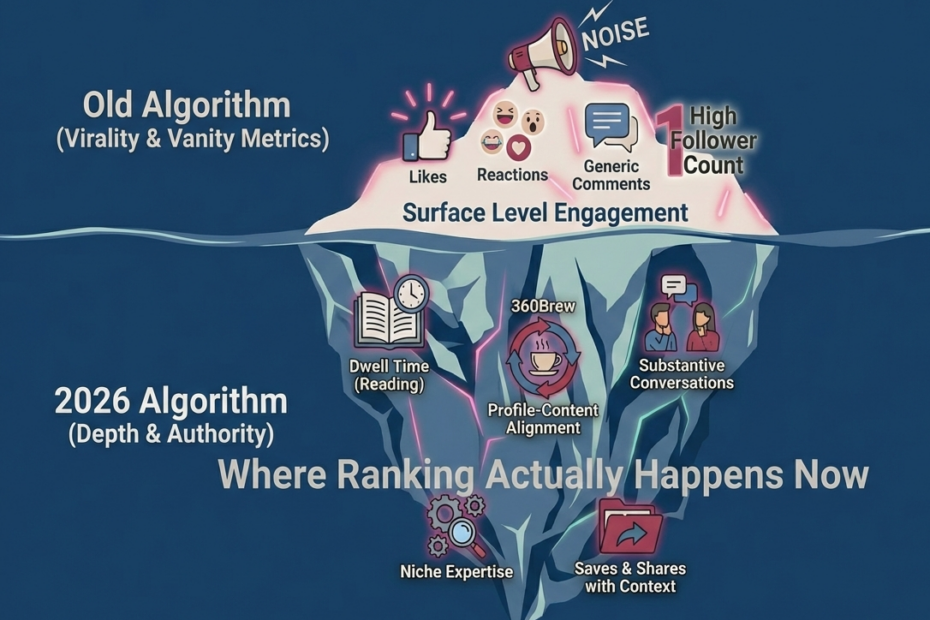
LinkedIn has deliberately shifted away from rewarding viral content toward prioritizing what they call “Depth and Authority.” The platform’s Director of Product, Alice Xiong, has been crystal clear: LinkedIn is “not designed for virality” but rather for knowledge-sharing and professional connections. If your content doesn’t align with your professional expertise, LinkedIn limits how far your posts get disseminated.
For job seekers with strong personal brands and consistent messaging, the Algorithm can work to your advantage. Stick to what you know best, and you will be rewarded.
How LinkedIn’s 2026 Algorithm Actually Works
Think of LinkedIn’s algorithm as a three-stage security clearance for your content. Each stage determines whether your post moves forward or gets stopped.
Stage 1: Filtering for Quality “Infractions”
Before your post reaches anyone, LinkedIn’s AI scans it for low-quality indicators:
- Engagement bait (e.g., “Tag someone who needs to see this!”)
- Excessive hashtags (Use 1-5 hashtags and choose niche-focused hashtags like #B2BSalesTips rather than generic ones like #Marketing). Note: Hashtags are viewed by some experts as obsolete. Personally, I’ve decided to de-clutter my posts by removing hashtags.
- Poor grammar or spelling errors
- External links (these now carry a 60% distribution penalty)
Posts are classified as spam, low-quality, or “clear” (high-quality). Only “clear” posts move to Stage 2.
Stage 2: The Golden Hour Test
The first 60-90 minutes after you post are now make-or-break. LinkedIn tests your content with a small sample of your audience. Here’s what they’re measuring:
- Dwell time: How long people actually read your post (the #1 ranking signal)
- Comment quality: Multi-sentence, substantive responses now count 15x more than likes
- Saves: Indicates high-value content worth revisiting
- Shares with context: Reshares that add commentary
If your post performs well in this initial test, it advances to broader distribution. If not, it dies quietly.
Stage 3: Relevance & Network Ranking
This is where the algorithm gets sophisticated. LinkedIn now performs what they internally call a “360Brew” analysis, checking whether:
- YOU are qualified to post about this topic: Your headline, skills, past content, and experience must align with what you’re sharing
- Your audience cares about this topic: Content is distributed to people who historically engage with your niche, even if they’re not connected to you
- The relationship strength exists: Your 1st-degree connections get priority, but relevant 2nd and 3rd-degree connections now see your content if it matches their professional interests
What This Means for Your Job Search
LinkedIn’s algorithm now rewards you for demonstrating expertise in your field, not for accumulating likes.
This fundamentally changes how you should approach LinkedIn during a job search.
What Gets Rewarded in 2026:
- Expert-led content: Frameworks, industry breakdowns, specific insights from your experience
- Native content: Content uploaded directly to LinkedIn (not links to external sites)
- Specificity: Company names, metrics, concrete examples, timeframes
- Original perspective: Your take on industry news, not just resharing it
- Long-form value: Substantive posts that take time to read
- Short video: Under 30 seconds with captions (200% higher completion rate)
- Articles and newsletters: Getting “unprecedented distribution” according to LinkedIn’s VP/Editor in Chief Dan Roth
What Else Gets Penalized:
- Generic motivational content (“Monday motivation!”)
- Overly promotional posts about your job search. This is considered an “ask” (you want something from the network) rather than a “give” (sharing expertise)
- AI-detected generic advice
- Engagement pods or artificial engagement
Six Strategic Shifts to Win the 2026 Algorithm
1. Build Authority in Your Niche
The algorithm now checks whether your profile supports your content. If you’re posting about cybersecurity but your profile says you’re in marketing, your reach gets throttled.
Action: Audit your profile for profile-content alignment. Your Professional Headline, About, Skills, and Experience should tell one coherent story.
2. Optimize for Dwell Time, Not Likes
Stop chasing vanity metrics. The algorithm cares most about how long people spend reading your post.
Action: Write scannable content with:
- A punchy first sentence that hooks attention
- 3-4 sentence paragraphs (not walls of text)
- Concrete examples and specific details
- A question or reflection that invites thoughtful responses
3. Prioritize Meaningful Comments Over Reactions
One substantive comment is worth 15 likes in the algorithm’s eyes.
Action: End your posts with a genuine question that invites specific insights, not just agreement. Respond to every comment with substance to keep the conversation going. The algorithm tracks how long comment threads remain active.
4. Post During Peak Engagement Windows
Timing matters more than ever to optimize engagement patterns.
Action: Schedule posts for:
- Morning Golden Hours: 8-10 AM (when executives check LinkedIn before meetings)
- Lunch Rush: 12-2 PM
- Evening Sweet Spot: 6-8 PM
Test which window works best for your specific network.
5. Share What You’re Uniquely Qualified to Discuss
Generic leadership advice gets buried. Specific insights from your experience get amplified.
Action: Instead of “5 tips for capturing new clients,” share “The exact email template that landed me 12 new clients at Fortune 500 companies” with the actual template and your results.
6. Engage Consistently, Not Sporadically
The algorithm rewards regular participants, not occasional visitors.
Action: Commit to “little and often”. Perhaps:
- Post 1-2 times per week with substantive insights
- Comment meaningfully on 3-5 relevant posts daily
- Engage in the first 90 minutes after posting
Consistency over 30 days beats sporadic bursts of activity.
Your Content Strategy for Job Seekers
Let’s get practical. Here’s what to actually post when you’re in a job search:
High-Performing Content Types:
Industry Insights with Your Take
- “I just read [article] about [topic]. Here’s what they missed…”
- “Three trends I’m seeing in [your industry] that nobody’s talking about”
Problem-Solving Frameworks
- “The exact process I used to [achieve specific result].”
- “How I approach [common challenge in your field].”
Behind-the-Scenes Professional Development
- “I’m upskilling in [specific area]. Here’s what I’m learning and why it matters.”
- “I attended [conference/webinar]. Here are my three biggest takeaways.”
Lessons from Your Experience
- “The biggest mistake I made in [situation] and what I learned”
- “How I solved [specific problem] at [company] using [approach]”
The One Thing You Must Stop Doing
If you take away one change from this post, make it this: Stop using external links in your posts.
External links now carry a 60% distribution penalty because LinkedIn wants to keep users on their platform. Instead:
- Share insights from articles in your own words, crediting the source
- Upload documents, images, or videos natively to LinkedIn
- Use LinkedIn Articles for long-form content instead of linking to your blog
- Put links in the first comment if you must share them
Your 30-Day LinkedIn Algorithm Challenge
Don’t just read this and move on. Commit to one strategic shift for the next 30 days:
Week 1: Audit your profile for profile-content alignment. Update your Professional Headline, About, Skills, and Experience sections to reflect your target role.
Week 2: Post one piece of expert content from your experience. Focus on specificity and concrete examples.
Week 3: Engage meaningfully with 15-20 posts from industry leaders and target companies. Leave substantive comments that add value.
Week 4: Analyze what worked. Which post got the most dwell time? Which comments sparked conversations? Double down on what resonated.
The algorithm isn’t your enemy. It’s a filter that rewards authentic expertise and meaningful engagement. Show up consistently as the expert you are, and the right opportunities will find you.
Your LinkedIn lighthouse is waiting to be lit. Time to flip the switch.