AI tools like ChatGPT and Google Gemini are changing the way we write resumes and cover letters, and for the most part, that’s a good thing. They help us organize our thoughts, improve grammar, and overcome writer’s block. But there’s a line between using AI and leaning on it too much, and many job seekers are crossing it.
“Every sentence is grammatically correct, evenly spaced, and emotionally vacant. Real résumés have scuff marks.”
– Steve Levy, Business Insider
Recruiters and hiring managers are noticing distinct patterns in AI-generated resumes and cover letters, many of which are turning into red flags.
Red Flags in AI-Generated Resumes and Cover Letters
When applications are overly reliant on generative AI, recruiters notice:
- Buzzwords and hollow jargon. Terms like dynamic, innovative, proven track record, and cross-functional appear without any real context.
- Category headers. Bullets open with a label like “Strategic Leadership:” followed by a full paragraph instead of a concise bullet.
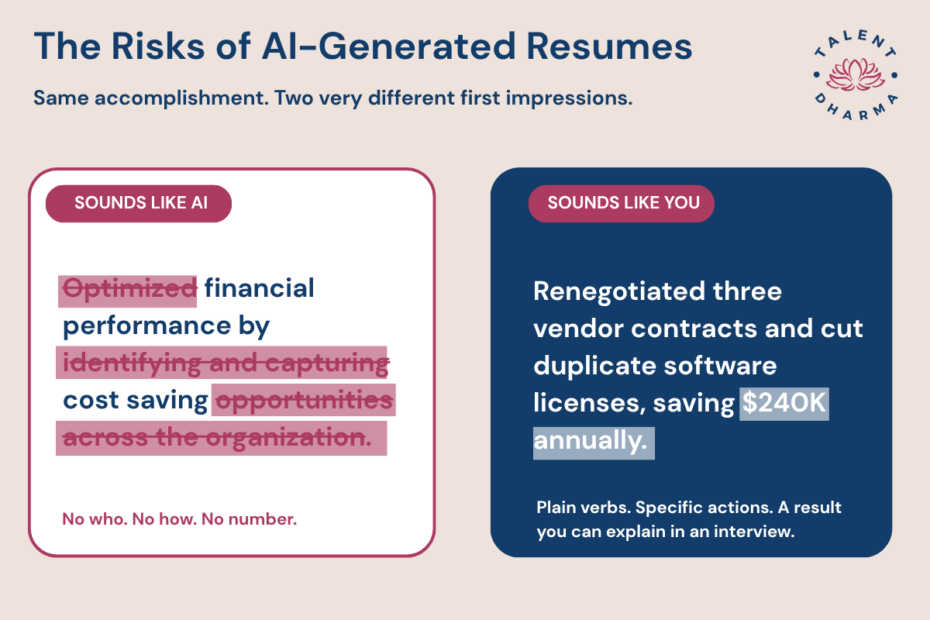
- Generic tone. Grammatically perfect, emotionally flat. Example: “Optimized financial performance by identifying and capturing cost-saving opportunities across the organization.” Better: “Renegotiated three vendor contracts and cut duplicate software licenses, saving $240K annually.”
- Lack of personalization. The document could be sent to any company for any role. Example: “I am excited to apply for the Customer Experience Manager position at your organization. With my proven track record and passion for innovation, I am confident I would be a valuable addition to your team.” Better: “Your commitment to making healthcare scheduling simpler is personal for me. I spent three years helping patients navigate that exact process.”
- Missing motivation. Cover letters skip your real reason for applying.
- Inconsistencies. Dates, titles, or facts don’t match your LinkedIn profile or what you say in interviews.
- AI hallucinations. AI sometimes invents responsibilities or achievements, and the candidate doesn’t notice.
Unfortunately, when generative AI is overused or poorly applied in resumes and cover letters, it can send several negative signals about both your candidacy and your potential as a future employee.
What It Says About You as a Candidate
“Everyone is dealing with a sea of sameness … it’s really generic … AI is a helpful tool, but when it’s trying to do too much for you, it erases your personality.” –Nicky Hutchinson, Financial Times
Used carelessly, AI can signal that you:
- Aren’t being authentic. You’re presenting a version of yourself that isn’t real.
- Aren’t that interested. No customization suggests you didn’t study the role.
- Are careless. Inaccurate details and formatting slips damage credibility.
- Lack communication skills. A voiceless application raises doubts about how you write and speak.
- Lack creativity: The writing doesn’t reflect original thought or perspective.
Use AI to Check Your Work, Not Do Your Work
It’s understandable to be tempted, especially when you’re tailoring a resume for every application. But your resume is a first impression, and in this market authenticity stands out more than polish. Use AI to:
- Evaluate whether your resume addresses the minimum qualifications of the job.
- Correct spelling, grammar, and syntax errors.
- Reverse-engineer keyword gaps between your resume and the job description, then write the fix yourself.
- Tighten sentences you already wrote (cut filler, fix passive voice) instead of generating new ones.
- Check for ATS formatting issues like tables or columns that don’t parse cleanly
Let AI check your work, not do your work, and make sure every line is something you could explain out loud in an interview.